
· by Michael Blair, Nashville's Garage Door
Most people never look at the lift cables until one of them looks fuzzy, hangs loose or lets go. They are the two steel lines that run up the sides of a sectional garage door from its bottom corners, and on a door with springs above it they do a heavier job than their size suggests. Search for “garage door cable replacement” and you get a lot of instructions; here is what the cable actually does, why it wears out, what a frayed one means for the door, and why replacing it belongs with a technician. Cable work is part of our off-track and cable repair service.
What the lift cable does
The springs store the force that lifts the door, and the cables deliver it. Clopay’s guide to the main components of a garage door describes them as strong, flexible steel, fastened at the bottom corners of the door and running up to the drums near the top, working with the springs to raise and lower it. The same page says that, like springs, cables are under a lot of tension.
The industry writes a standard for these cables. DASMA 110, the Door & Access Systems Manufacturers’ Association standard for lifting cables on sectional doors, dates from 2010. It requires a cable to survive at least 10,000 door cycles in an endurance test, and it sizes the cable with a 5 to 1 safety factor, so the most a cable is meant to carry in service is one fifth of its breaking strength. In the standard’s table, a 1/8-inch cable of 7x19 construction breaks at 2,000 pounds and is matched to a door of no more than 800 pounds on two cables.
Why does a garage door cable fray?
It frays from the work it does: every trip up and down, the cable winds onto its drum, bends around it, straightens out and bends again. The commentary in DASMA 110 says its endurance test exists to measure exactly those two things, the frictional wear of the cable running over a drum and the fatigue of bending and straightening, and it calls for the cable to wrap the test pulley the way it wraps a drum on a real door.
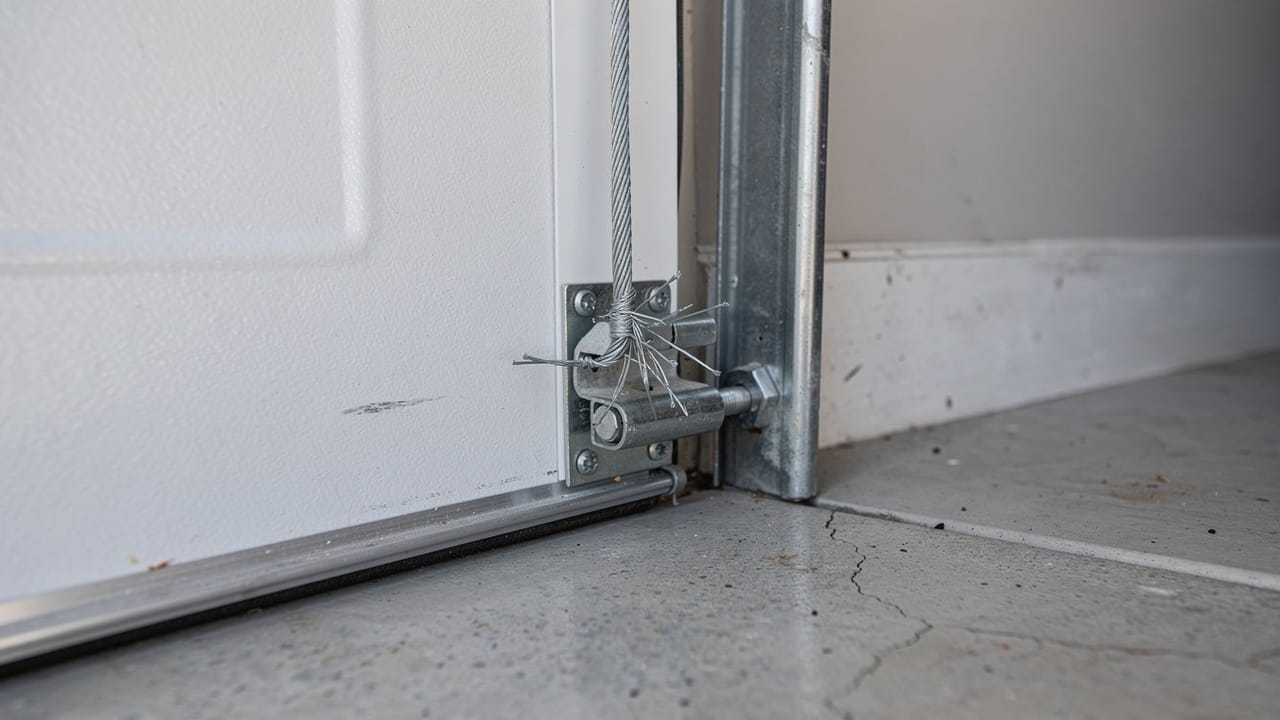
The standard is strict about what counts as worn out. An endurance failure is the severing or fraying of at least one strand, and a cable is counted as broken when one strand is severed. So by the measure the cable was built to, the first broken wire you can see is not an early warning; it is a cable that has reached the end of its test.
The same standard notes that uneven stretch between the two cables, or too much stretch in one, can leave a cable slack. A slack cable on one side is a sign the pair is no longer sharing the load evenly, and it is one of the first things our technician looks for when a door hangs lower on one side.
Is a frayed garage door cable an emergency?
A frayed garage door cable is a reason to stop using the door and call, because DASMA’s garage door safety tips say a frayed or worn cable is in danger of breaking, and a break can cause injury. Clopay puts it the same way: cables, like springs, can snap when they are worn or frayed.
Until the door is looked at, leave it where it is and keep cars and people out from under it. Look from a step back without touching anything: broken strands sticking out of the cable, a flattened or shiny worn spot, a cable hanging slack beside the track, or a door sitting crooked. Clopay adds two signs you may notice first. An opener that hums while the door stays put can mean a broken spring or cable, and a door that shakes or looks crooked can point to the same thing. A door that has already come out of its rollers is a different situation, covered in our post on a garage door that is off track.
Who should replace a garage door lift cable?
A trained door technician. DASMA’s safety tips say that, because of the high spring tension, cables should be replaced only by a trained technician, and that the bottom brackets the cables fasten to are under extreme tension and should be adjusted only by one. Clopay’s guide also says to call a professional for frayed cables rather than attempt the repair.
On our visits the springs are unloaded before either cable comes off, and both cables are replaced together, even when only one shows wear. The two have run the same number of cycles, and DASMA 110’s note on uneven stretch is the reason we do not pair a new cable with an old one. While the tension is off we look at the drums for wear or damage and at the springs, which share the same cycles; the spring side of the job is described on our spring repair page and in our post on how long garage door springs last. Then the door is rebalanced, lifted by hand to check it stays put, and its opener reversing is tested.
A look at the cables is part of every tune-up and safety visit, and we do that work in Murfreesboro, Nashville and across Middle Tennessee. If you can see a frayed strand now, ask us for a written price and tell us which side it is on.
Sources
- DASMA 110-2010, Standard for Lifting Cables for Sectional Type Doors (Door & Access Systems Manufacturers’ Association, 2010) — 4.2.8: at least 10,000 door cycles per ANSI/DASMA 102; 4.2.9: endurance failure is severing or fraying of at least one strand; 4.3.5: breaking is severing of one strand; 4.4.1 and C5: uneven or excessive stretch can result in slack cables; 4.4.2: 5 to 1 safety factor; Table 2: 1/8 in. 7x19 cable, 2,000 lb breaking strength, 800 lb door on two cables; commentary: the test measures wear over a drum and bending fatigue.
- DASMA, Garage Door Safety Tips — Inspect the cables that attach the spring system to the bottom brackets; frayed or worn cables are in danger of breaking and can cause injury; cables should be replaced only by a trained technician; bottom brackets are under extreme tension.
- Clopay, Main Components of a Garage Door — Cables are strong flexible steel attached at the bottom corners and running to the drums; under tension and can snap if worn or frayed; call a professional; an opener that hums while the door does not move, or a door that shakes or looks crooked, can mean a broken spring or cable.
FAQ
Frayed or Snapped Garage Door Cable: What It Takes — questions
Can I repair a garage door cable on my own?
We advise against it. DASMA says that, because of the high spring tension, lift cables should be replaced only by a trained technician, and that the bottom brackets they fasten to are under extreme tension. Clopay also says to call a professional for frayed cables. The springs have to be unloaded safely before a cable comes off.
Should I replace both garage door cables at once?
Yes, and we do it that way on every job. The two cables have run the same number of cycles, so the second is usually close behind the first. DASMA’s cable standard also notes that uneven stretch between the pair can leave one cable slack, which a new cable beside an old one invites.
How can I tell if a garage door cable is bad?
Look without touching. Broken strands sticking out, a flattened or shiny worn spot, or a cable hanging slack beside the track all mean it needs replacing. Clopay adds that an opener that hums while the door does not move, or a door that shakes or sits crooked, can point to a broken cable or spring.
Why do my garage door cables keep coming off?
A cable that keeps coming off its drum is usually slack, and slack has a cause. DASMA’s cable standard names uneven stretch between the two cables, or too much stretch in one, as a way cables go slack. Resetting the cable without finding that cause means it happens again, so we check the pair, drums and springs together.